

You’ll find it surprising that offshore wind farms now power millions of homes worldwide, with China leading the charge at 75 GW of capacity. The industry’s rapid expansion has caught the attention of major investors, who poured $180 billion into new projects last year alone. As costs drop and technology improves, these massive turbines are transforming our energy landscape – and the numbers tell an even more compelling story.
Global Offshore Wind Capacity Milestones

Three key milestones mark the growth of U.S. offshore wind power since 2016.
The first commercial offshore wind farm at Block Island launched with 30 Megawatts, followed by Virginia’s 12-Megawatt pilot project in 2020.
Regional Market Leaders and Performance Metrics
While the U.S. offshore wind sector takes shape, global wind power markets show remarkable regional diversity.
China’s dominance continues with 75 Gigawatts of new capacity, while Brazil’s impressive 4.9 Gigawatts establishes it as the third-largest market.
China leads global wind power growth with 75GW, as Brazil emerges strongly with 4.9GW to claim third place worldwide.
Denmark leads in renewable power, generating 56% from wind.
Germany’s 3.2 Gigawatts and Asia’s offshore wind market growth highlight expanding regional capabilities.
Investment Trends and Economic Impact
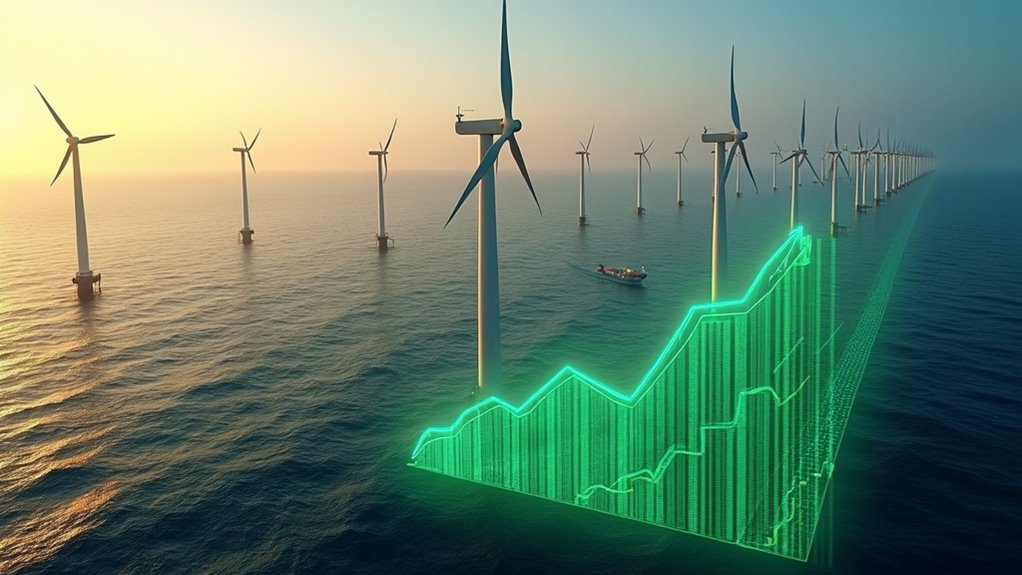
As offshore wind power gains momentum globally, investment figures paint an impressive picture of the industry’s growth.
The wind power sector saw $180 billion in investments for 2023, with offshore projects securing $65 billion by 2030.
You’ll find the economic impact extends beyond clean energy capacity, creating 56,000 U.S. jobs and establishing new supply chains worth over $4 billion.
Technology Advancement and Cost Reductions
Recent technological breakthroughs have dramatically lowered the costs of offshore wind power production.
Here’s what you’ll find in today’s global offshore wind sector:
- Floating offshore wind costs are expected to drop 80% by 2050.
- Modern turbines now reach 8-12 MW capacity.
- Global manufacturing capacity’s growing to 205-260 GW by 2023.
- Offshore wind capacity added 116 GW in 2023, showing 12.5% growth.
Job Creation and Supply Chain Development
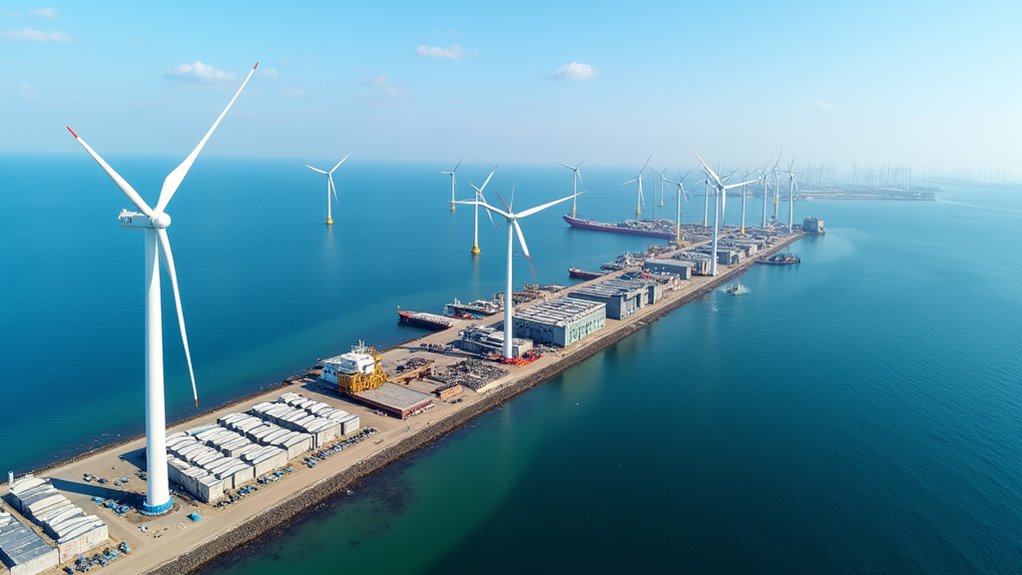
Since the offshore wind sector continues to expand rapidly, it’s creating thousands of new job opportunities across America.
The booming offshore wind industry is driving major job creation and economic growth throughout the United States.
You’ll see $65 billion in U.S. investment by 2030, generating 56,000 new positions.
A $4 billion investment is building supply chains and revitalizing local economies.
The growth supports manufacturing, ports, and workforce development, strengthening renewable energy’s future in America.
Project Pipeline and Future Deployments
The U.S. offshore wind industry’s workforce expansion aligns perfectly with ambitious deployment targets on the horizon.
You’ll see remarkable growth in global energy transformation through:
- $65 billion in U.S. investment creating 56,000 jobs by 2030
- Nine European nations expanding from 30 GW to 120 GW by 2030
- U.S. targeting 115,000 MW of offshore wind capacity by 2050
- Floating offshore wind projects advancing in France, Japan, and the U.S.
Environmental Benefits and Power Generation Data
Moving closer to coastal population centers, offshore wind farms deliver clean energy right where it’s needed most.
With 80% of Americans living within 200 miles of coastlines, power generation from these facilities efficiently meets high electricity demands.
Global offshore wind’s share in renewable energy will surge from 8% to 34% by 2050, while floating wind costs will drop 80%, making clean electricity more affordable.