
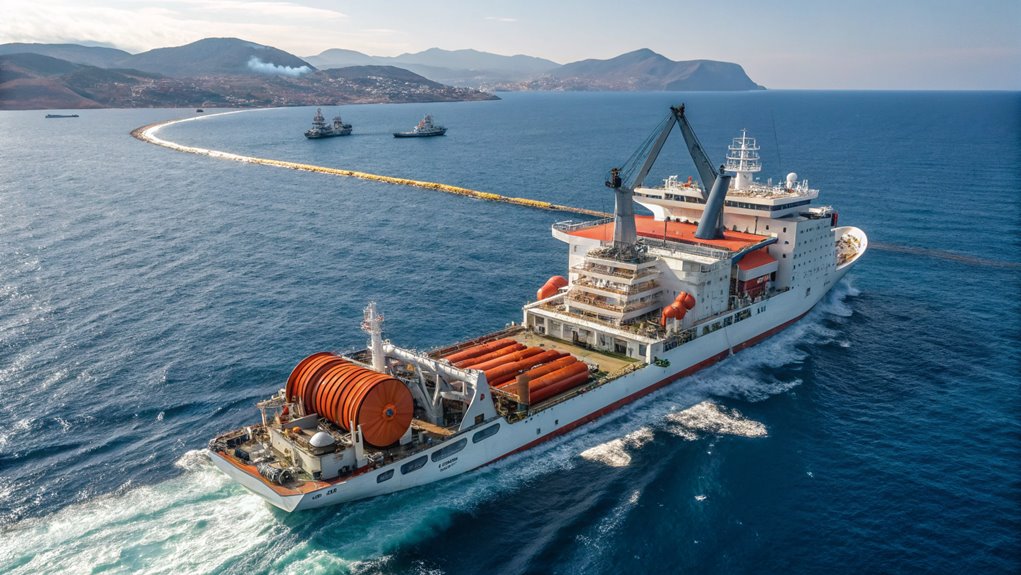
Renewable Energy Revolution Takes Shape: Offshore Installation Activities Connect Sicily, Sardinia, and the Italian Peninsula
Italy's latest renewable energy venture is nothing short of transformative as offshore installation work begins to bridge Sicily, Sardinia, and the mainland. These connections, far from just being cables under the sea, are pathways to a greener future centered on floating wind farms. Turbines are being carefully positioned to capture ideal winds while staying discreet, promising a significant transformation of Italy's energy landscape. The real impact, however, extends far beyond the technical achievements.
Pioneering Floating Offshore Wind Projects
Recently, the Italian authorities approved the country's first floating wind farm, known as 7SeasMed, which will be located just over 20 miles off the coast of Sicily. This 250MW project, led by Copenhagen Offshore Partners and owned by a consortium including GreenIT and Copenhagen Infrastructure Partners, is expected to provide around five percent of Sicily's total electricity consumption, powering more than 70,000 homes.
Moreover, Italy has also seen the development of hybrid floating solar–floating wind farms. The Corigliano project, located off the southern coast in the Ionian Sea, is a prime example. This 540MW hybrid project will feature 420MW of offshore wind and 120MW of floating solar, demonstrating Italy's commitment to innovative renewable energy projects.
Regulatory Support and Future Ambitions
The Italian government has implemented the 'FER2' decree, legislation that supports the development of innovative renewable energy projects, including offshore wind and floating offshore wind. This decree provides an offtake mechanism that will support the generation of electricity from renewable energy, stimulate competitiveness, and help Italy meet decarbonisation targets. It is expected to be particularly important for the development of offshore wind and floating wind in Italy, with over 15GW of offshore wind projects in the pipeline.
According to strategic reports, Italy's focus on floating offshore wind is due to its strong energy potential and limited environmental and social impact. The European House Ambrosetti estimates that Italy could become the third largest market worldwide in terms of floating offshore wind farms, with a potential of 207.3GW. This ambitious target is part of Italy's long-term decarbonisation goals, aiming to develop at least 20GW of floating wind energy capacity by 2050.
An executive from The European House Ambrosetti said, "To reach Italy's long-term decarbonisation targets, at least 20 GW of floating wind energy capacity must be developed by 2050."
The real transformation, however, will not just be about the technical achievements, but about how these projects reshape Italy's energy future and contribute to a greener, more sustainable landscape.
Italy's ambitious offshore wind projects are transforming the country's renewable energy landscape along its Mediterranean coastlines, with two groundbreaking floating wind farms poised to make a significant impact. Off the coast of Sicily, 21 turbines are being installed, while 42 turbines are being positioned off the shores of Sardinia, located more than 35 kilometres from land to maximise wind capture while minimising visual impact.
These projects not only aim to generate power but also to revolutionise Italy's energy future. Once operational, these wind farms will produce over 2,000 GWh annually, enough to power roughly 750,000 homes, representing a 50% increase in output compared to a similar onshore wind farm. This investment is particularly attractive despite the high initial costs due to its potential to contribute significantly to the decarbonisation objectives of the 2030 National Integrated Energy and Climate Plan.
The projects are creating opportunities through public-private partnerships and EU funding, addressing concerns from fishing and tourism sectors. Protected fishing zones around the wind farms could actually help fish populations thrive. The timeline for these projects is already in motion, with Sicily's turbines expected to be operational by 2026, followed by Sardinia's in 2028. The development is being supported by Lilybeo Wind Power S.r.l. in Sicily's offshore initiatives.
Sicily faces some infrastructure hurdles with its ports, which are undergoing modernisation efforts to handle the massive turbine components. These projects will prevent about 1 million tonnes of carbon dioxide emissions annually, contributing significantly to a low-carbon future.
The success of these installations depends on careful planning and community engagement, with ongoing public consultations ensuring that everyone's voices are heard as Italy moves toward a greener future with these innovative offshore wind farms.
According to GreenIT and Copenhagen Infrastructure Partners, "the two wind farms will produce more than 2,000 GWh/year, which is equivalent to the average annual energy consumption of approximately 750,000 households in the involved areas that represent an increase of around 50% more than the average output of an onshore wind farm in Italy, at the same average installed capacity."
Italy's proactive approach in developing its offshore wind sector aligns with the broader Mediterranean strategy, which aims to harness the region's moderate and constant winds ideal for offshore wind projects, promoting sustainable and clean energy while minimising environmental impact.