
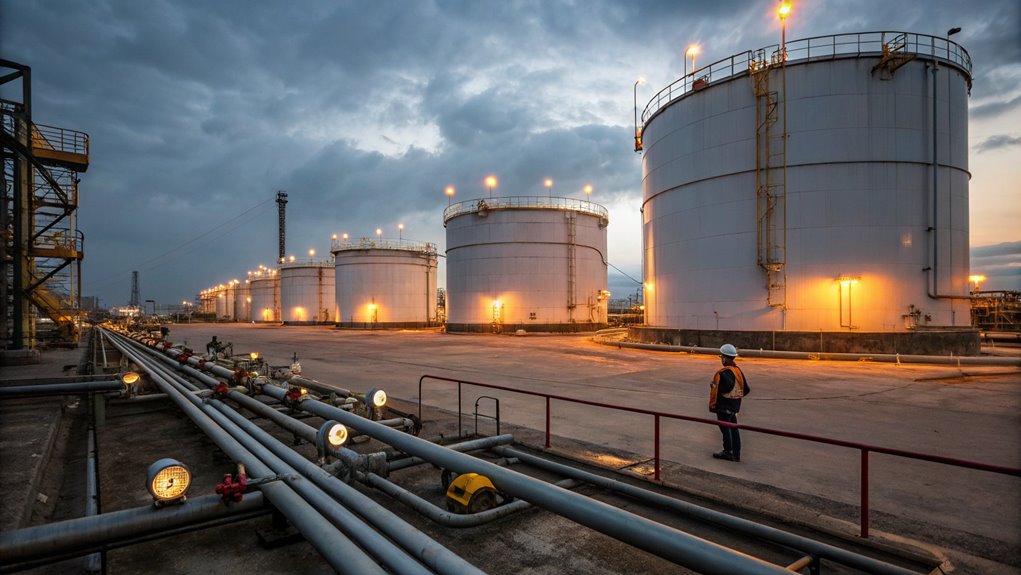
The UK's gas storage reserves have reached alarmingly low levels, standing at approximately 50% capacity according to recent reports. This critical situation raises significant concerns about the nation's energy security, particularly as winter deepens and demand surges. When compared to neighboring European countries, which maintain considerably larger storage facilities, Britain's limited storage capacity leaves it more susceptible to supply disruptions and price volatility.
Centrica's CEO, Christopher O'Shea, has voiced these worries, stating that he is "worried" about low gas reserves this winter. According to O'Shea, "We need the lights to go on every time the switch is flicked anywhere in the country. And we're too close to that not being the case for comfort in my view".
The strain on the UK's gas supply system is exacerbated by the cessation of Russian gas pipeline supplies through Ukraine, which ended last month. Moreover, the Rough gas storage facility, which accounts for roughly half of the UK's gas storage capacity, has seen its reserves deplete rapidly. Since early November, it has delivered nearly 420 million cubic meters of gas—enough to heat 3 million homes daily, but its current inventory is 20% lower than at the same time last year.
O'Shea emphasized the need for long-duration energy storage, particularly as the UK works towards Clean Power 2030. "As we work towards Clean Power 2030, long-duration energy storage will be needed more than ever in order to help balance a system that is increasingly reliant on renewables. Energy storage is what keeps the lights on and homes warm when the sun doesn't shine and the wind doesn't blow, so investing in our storage capacity makes perfect economic sense," he noted according to recent interviews. This underscores the pressing need for immediate action to bolster the UK's energy infrastructure and prevent a potential crisis during peak demand periods.
UK Gas Storage Crisis Intensifies
The UK's gas storage crisis has intensified as winter temperatures plummet, with reserves now at just half capacity – a significant drop from last year's inventory.
The UK's storage capacity, approximately 3.2 billion cubic meters, is significantly lower than that of neighboring countries, with Germany's capacity being seven times larger and the Netherlands' five times larger.
According to Jess Ralston, Head of Energy at the Energy and Climate Intelligence Unit (ECIU), "Gas prices remain volatile as we approach the fourth year of the gas crisis and, as the North Sea continues its inevitable decline, unless the UK starts to reduce its demand for gas then we'll just become more dependent on imports from abroad, with prices set by the international markets".
This discrepancy in storage capacity means the UK can only rely on its gas reserves for about 12 days during winter, in stark contrast to Germany's 89 days.
The UK's reliance on real-time supply over extensive storage has historically made it vulnerable to price spikes during peak demand periods.
As of January 10, 2025, Centrica reported that the UK's gas stocks were 26% lower compared to the same time last year, with storage facilities across the UK only 42% full.
The Rough storage facility, with a capacity of 1.5 billion cubic meters, remains the UK's largest gas storage site and plays a crucial role in maintaining energy security.
This situation has been exacerbated by the cessation of Russian gas supplies through Ukraine, which has further strained the UK's energy market.
Despite these challenges, the National Grid operator has reassured the public that the country will have enough gas to sustain heating through the winter, thanks to a diverse range of gas sources beyond stored reserves.
However, calls for the UK government to bolster its gas storage capacities have been made, with Centrica proposing a significant investment aimed at restoring the Rough facility to its full capacity.
According to Chris O'Shea, group chief executive of Centrica, "The UK's gas storage levels are concerningly low. We're an outlier from the rest of Europe when it comes to the role of storage in our energy system and we're now seeing the implications of that".