
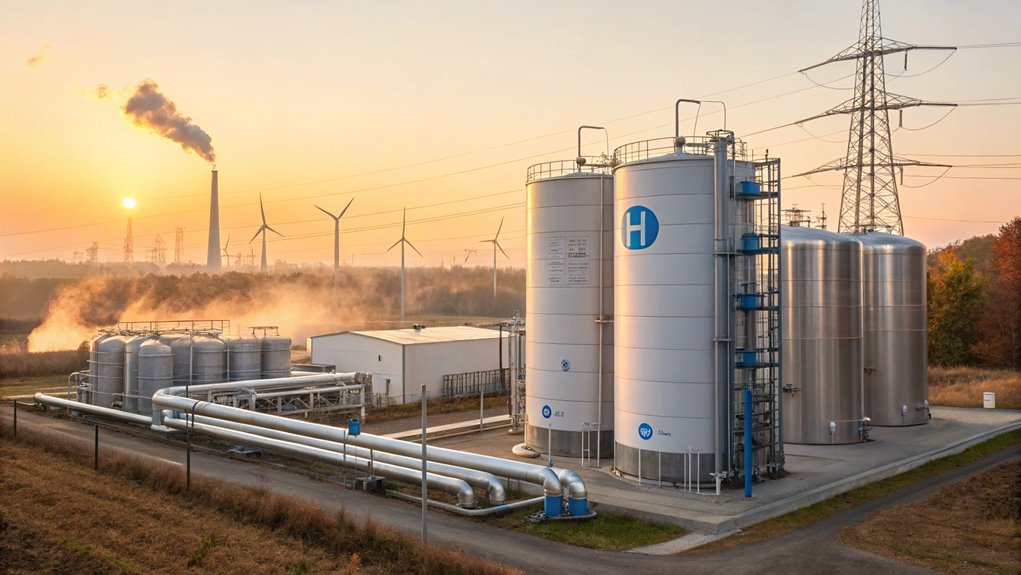
The European Union has recently made a significant investment of over €250 million in hydrogen infrastructure projects, a move that underscores its commitment to reshaping Europe's energy landscape. This substantial funding will be distributed across various projects, including the H2Med corridor and the Nordic-Baltic Hydrogen Corridor, which are pivotal in facilitating Europe's transition to a decarbonised energy system.
By 2030, Europe's hydrogen production is projected to reach 20 million tons, making these infrastructure projects crucial in supporting this ambitious goal. The Nordic-Baltic Hydrogen Corridor, for instance, aims to connect production centres in North-East Europe with consumption centres in Central Europe, with the potential to transport up to 2.7 million tons of renewable hydrogen annually by 2040.
The project's pre-feasibility study, completed in July 2024, has shown promising results, highlighting the region's significant renewable hydrogen potential and the corridor's potential to reduce carbon emissions by up to 37 million tons of CO2 equivalent per year by 2050.
According to the European Clean Hydrogen Alliance, "an integrated hydrogen backbone (network of hydrogen pipelines and storage sites) is a key enabler for cost optimisation – thus protecting the competitiveness of European energy-intensive industries". This underscores the importance of these infrastructure projects in achieving Europe's decarbonisation goals.
The EU's investment in hydrogen infrastructure is part of its broader strategy to support the uptake of renewable and low-carbon hydrogen, as outlined in the REPowerEU plan and the hydrogen strategy. With projects like the Nordic-Baltic Hydrogen Corridor and the H2Med corridor receiving substantial funding, Europe is taking a significant step towards a sustainable and decarbonised energy future.
EU's Strategic €250M Investment in Hydrogen Infrastructure
The European Union has announced a significant investment of €250 million in hydrogen infrastructure projects across the continent, as part of its efforts to meet ambitious climate goals. This funding is distributed across several key initiatives, including €94 million for the H2Med corridor and €51.4 million for the Nordic-Baltic Hydrogen Corridor, aimed at building a robust hydrogen network throughout Europe.
The investment is crucial, given the EU's need for between €28-38 billion for internal pipelines and another €6-11 billion for storage to transport approximately 20 million tonnes of renewable hydrogen by 2030. Although substantial, this is modest compared to the €584 billion required for electricity grid investments by the same year.
The EU's strategy is grounded in economic logic, as producing hydrogen near renewable energy sources is significantly cheaper than converting electricity to hydrogen at consumption sites. This plan is part of a broader €1.25 billion investment from the Connecting Europe Facility, focusing on both hydrogen and offshore electricity grids. The SoutH2 cluster has received 24 million euros for expanding hydrogen development across Italy, Austria, and Germany.
However, challenges remain, as nearly one in five European hydrogen projects were canceled in 2024, representing 29 gigawatts of missed green energy capacity. Despite this setback, about 250 renewable hydrogen projects are in various stages across the EU, with more on the horizon.
The European Hydrogen Bank offers €3 billion in subsidies, and member states have pledged billions more through initiatives like Hy2Move and Hy2Infra, indicating a serious commitment to making hydrogen infrastructure a reality in Europe.
According to Sara Kärki, Senior Vice President, Hydrogen Development at Gasgrid: "This is excellent news for Finland, the Baltic Sea Region, and the European hydrogen economy as a whole. The decision shows that Finland and the Baltic Sea Region is a strategically important and very competitive region for the development of the hydrogen economy and support EU-climate targets."
The European Commission has emphasized the importance of hydrogen infrastructure projects, such as the H2Med and Nordic-Baltic Hydrogen Corridor, in achieving Europe's climate neutrality goals. With continued investment and support, the EU aims to establish a comprehensive hydrogen network by 2030.